|
Air Pollution: Health and Economics
By Eddy Aboudi
Introduction
Air pollution levels are a concern due to toxins such as ultrafine particulate matter from metals, polycyclic aromatic hydrocarbons [PAHs] and unburned oil droplets. Toxicological data is still lacking in reference to nano-pollutants because traditionally it has been difficult to measure. And, combustion processes emitting gases such as oxides of nitrogen (NOX), carbon monoxide (CO) and sulphur dioxide (SO2) are evident in the air. Exposure to air pollution is a health hazard and has an impact on indoor ventilation costs when natural ventilation is sufficient to maintain proper temperature and humidity levels.
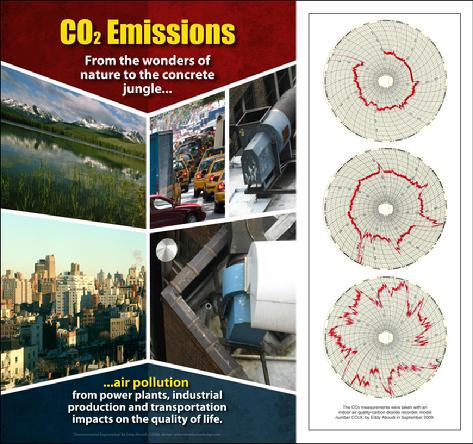
CO2 measurements have been taken in three naturally ventilated vacant locations. Indicated are different results.
The first chart, at the top, was recorded on a tree-lined block near a park and the river in the City of New York. It shows a low level of CO2. The measurement does not indicate the toxins in the air, nor does it reveal the sweet scent of cheery blossom trees.
The second measurement, in the center, had been taken in midtown Manhattan's commercial district. A heavily trafficked area with offensive pungent odors emanating from a restaurant's kitchen exhaust, in addition to an oil burner boiler emitting smoke, soot and dust blowing onto neighboring office buildings. The level of CO2 was relatively high. Opening up a window on a cool summer evening caused unpleasant working conditions.
The third chart, at the bottom, had been recorded in a rural area In Pennsylvania. It is about a half a mile away from a busy highway and near a coal-fired power plant where yellow smoke could be seen pouring from its tall chimney. Cars were covered with a film and pebbles of coal waste could be seen in the yards. The levels of CO2 were the highest on record.
Air pollution causes acid rain, contributing to respiratory diseases. Since the time of the Industrial Revolution, it has been evident that the air we breathe has a direct impact on our health. The air quality in the United States has improved since the passage of the Clean Air Act in 1970, however, air pollution still posses a threat to human health. In 2005, the Environmental Protection Agency (EPA) estimated that over 122 million Americans live in areas with poor to marginal outdoor air quality. It's comparable to living in a third world country.
Living and working in hazardous environments will require new methods of air cleaning. Natural ventilation will reduce energy consumption. Air filters for HVAC equipment and air purification equipment should be updated and upgraded regularly. Planting trees and cleaning the air we breathe are a top priority.
References
www.EPA.gov
"Cleaning the Air at the Expense of Waterways" by Charles Duhigg, New York Times, October 13, 2009, page one.
|